
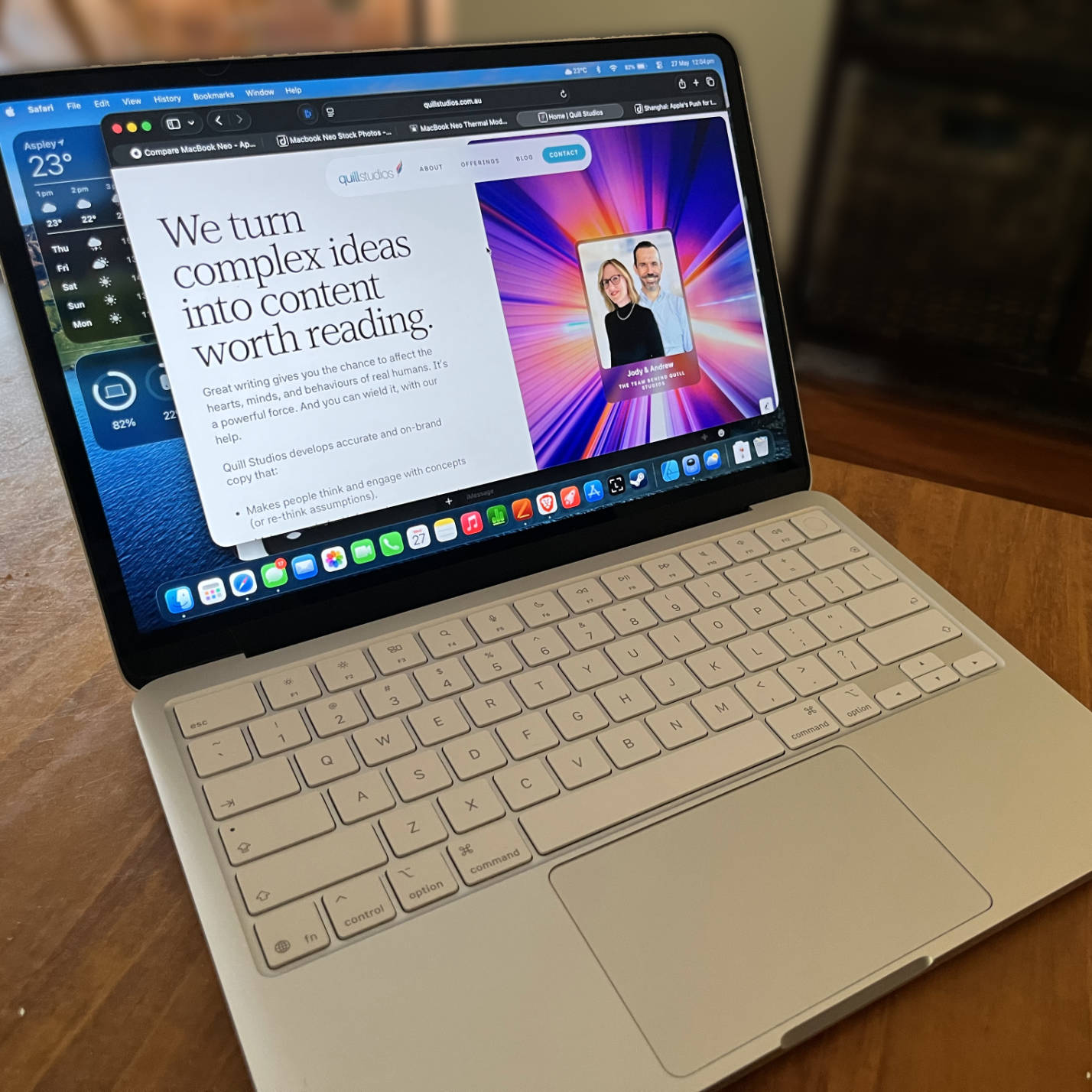
Last month I picked up the new MacBook Neo, I've spent the past few weeks putting it through its paces to see if Apple’s cheapest and least powerful laptop is enough Mac to keep up with my productivity needs. Short answer, yes it is.
If you’re not aware, the Neo represents Apple’s foray into the budget laptop market. It comes in two flavours; the cheaper version which has 256gb of storage and retails for AUD$899 and the up-specced version which has 512gb of storage, a built-in Touch ID scanner and retails for AUD$1099. I got the up-specced version, 256gb storage wasn’t enough for our needs.
Apart from storage and the Touch ID scanner the two versions are identical. Both versions sport Apple’s A18 chip — the same one used in the iPhone 16 Pro — 8gb of ‘unified RAM’, a 13 inch liquid retina display, 2 USB ports (only one is USB 3, the other is USB 2), 3.5mm headphone jack and all aluminium construction.
The first thing we noticed was just how premium the Neo felt for such an inexpensive laptop — it feels every bit as nice as the more upmarket laptops Apple offers. The screen is great, the keyboard feels good and the touchpad, while lacking the ForceTouch of its more expensive siblings, feels pleasing to use.
Unsurprisingly given its cost, there are a few notable features the Neo lacks in comparison to the more expensive MacBook Airs. In addition to the limited port selection the Neo’s keyboard isn’t backlit, the screen doesn’t feature TruTone technology and only covers the sRGB colour range, not P3, and the built-in webcam is only 1080p and lacks Center Stage. Honestly none of these omissions have been an issue in my usage.
The Neo’s day-to-day performance is a marvel at this price
I’ve been using the Neo as my primary work computer for the past few weeks, replacing my aging 2019 iMac which now no longer receives the latest MacOS updates. The old iMac was showing its age, it could still handle all the apps I commonly use, such as Pages, Chrome, Affinity Design, Affinity Photo, but it was starting to lag a bit and its lack of speed could sometimes be frustrating.
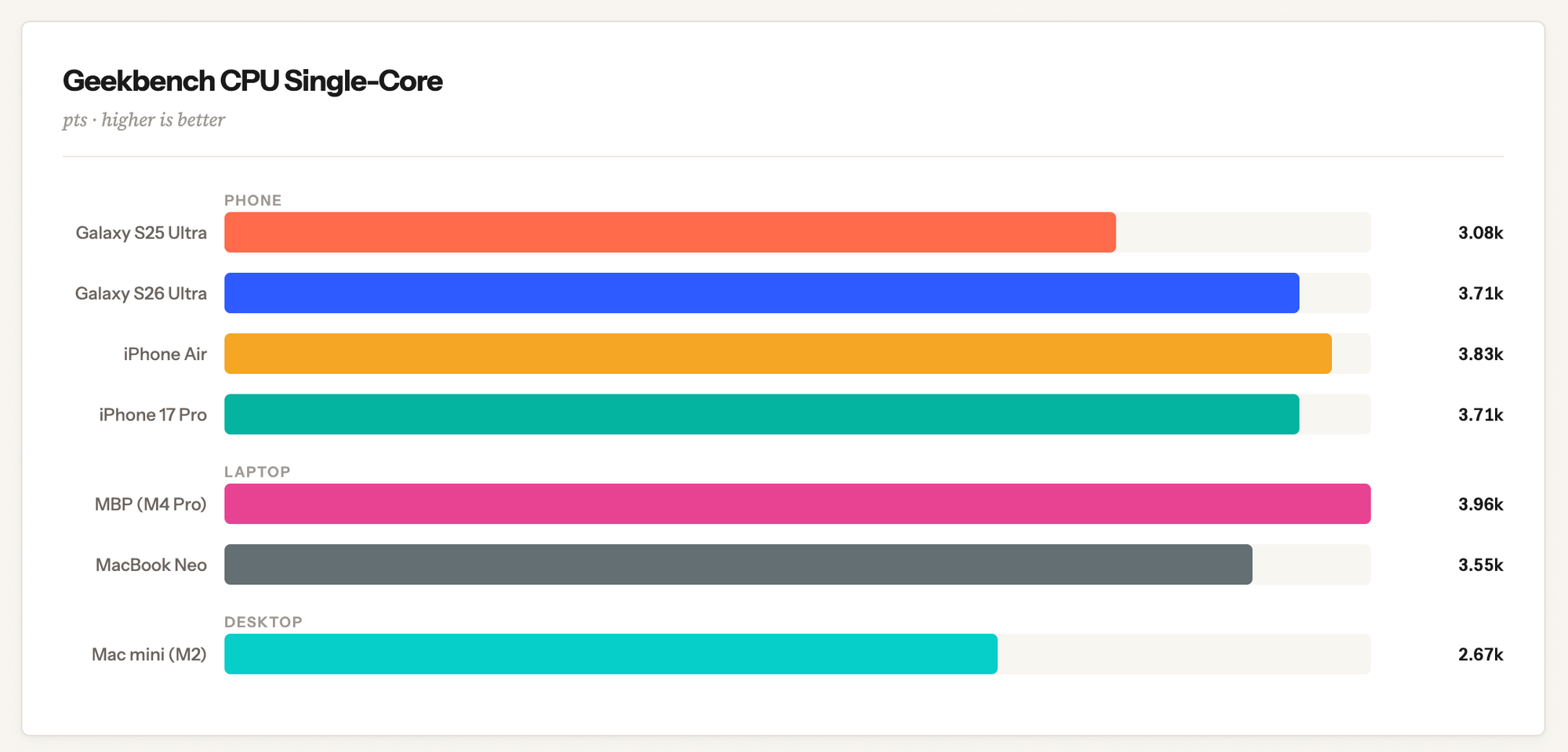
The Neo is an enormous step up in terms of performance. This is undoubtedly due in part to its solid state storage being significantly faster than the old iMac’s fusion drive. But its not just the faster drive, benchmarking also shows the Neo has outrageously good single core performance for its price — the Neo’s single core Geekbench results cluster around the 3500 range, while the 2019 iMac sits at around 1000-1200.
In fact, the Neo single core performance is so good it comes within about 10-15% of the much higher priced M4 MacBook Pro which was until recently Apple’s flagship laptop.
This enormous improvement in single core performance, combined with its SSD storage makes the Neo feel very responsive for everyday tasks, such as web browsing, using productivity apps like Pages and Mail and for basic design and photo editing tasks.
The Neo’s multi core performance though isn’t nearly as impressive, it’s roughly equal to the 2019 iMac but for my use case it’s mostly the single core performance I’m relying on so this isn't much of a concern for me.
So what have I done with the Neo? Mainly writing, emailing and web browsing — all fairly undemanding tasks. As you’d expect the Neo has handled these tasks really well, but even when I’ve being doing more resource intensive work like image editing the Neo hasn’t slowed down or stuttered.
There’ve been occasions where I’ve had Affinity Photo and Affinity Designer both running, each with multiple files open, 10-15 Chrome tabs open, Pages and Mail open and I haven’t noticed any appreciable slowdown. I don’t believe I’d see a substantial performance boost for my use case if I were to upgrade to a new MacBook Air or even a Pro.
You'd expect the 8gb of RAM might become an issue with all those apps open, but the Neo manages its relatively small memory endowment very efficiently. Back in 2023, Apple's global VP of product marketing, Bob Borchers, said that 8gb of Apple's unified RAM "is probably analogous to 16GB on other systems. We just happen to be able to use it much more efficiently." I don't know if that's entirely true or just a bit of marketing bluster, but in my experience the Neo certainly runs like a machine with more than 8gb of RAM.
I’ve even tried doing some gaming on the Neo, I’ve put a few hours into the turn-based strategy game Phoenix Point and the Neo has handled it great. It gets pretty hot and it churns through battery but it runs the game at an almost locked 60 frames per second. I plan on trying out the updated Civilisation 7 soon too, I’ve heard it also runs great on the Neo.
On that heat issue — the MacBook Neo doesn’t have fans so it can get hot and when it gets hot enough the CPU will be aggressively throttled to prevent damage, resulting in a substantial performance hit. Happily, this thermal throttling hasn’t been an issue in any of my work tasks to date.
To maximise performance and minimise the impact of thermal throttling (but mainly just because I enjoy tinkering) I decided to mod my Neo by adding thermal padding onto the CPU to allow the aluminium to case function as large heat sink and draw the heat away from the processor. Over the years this mod has been pretty popular among MacBook Air users (Airs also lack fans) and it seems to work quite well. Various YouTubers and tech bloggers have found this mod gives the Neo a performance boost of around 20%, particularly on more intensive multi core tasks like gaming and video editing where temperature can pretty quickly become a problem.
Budget Windows laptop makers could be in trouble
As you can likely tell, I’m very pleased with the Macbook Neo. For a computer built around an iPhone chip it’s crazy good. I know people love their MacBook Airs and MacBook Pros, but I think most Mac users wouldn’t notice a meaningful performance hit if they downgraded to a Neo — the only exceptions here would be those who do 4k video editing, some software developers and those running AI models locally.
The Neo is a marvel in my opinion, that Apple could create such a high quality laptop at this price point is really pretty astonishing. Budget Windows laptop manufacturers are on notice, the likes of Dell and Acer will need to up their games dramatically if they hope to maintain their market share of sub AUD$1200 laptops.